


Nearly 15 years ago, a handful of economists, engineers and regulators began wrestling with a question in Gujarat. Could factories be persuaded to cut pollution without fearing a shutdown?
Today, that experiment has an answer in the emissions trading scheme (ETS), which is travelling nearly 14,000 km from India and is poised to become one of the country’s newest environmental exports.
After transforming industrial pollution regulations in Gujarat and inspiring similar programmes in Maharashtra and Rajasthan, the idea that germinated in India is headed to Rio de Janeiro.
The Brazilian city has signed a letter of intent to examine adapting this approach to its own pollution challenges. If implemented, Rio would become South America’s first emissions trading system for industrial partic ulate pollution. For Delhi-NCR, which is annually in the news for its winter air pollution crisis, the Gujarat experience also offers a useful model, which is centred around incentives that make industries compete to pollute less, rather than punishing them when they pollute more.
For decades, India’s industrial pollution control has relied largely on periodic inspections and shutdown notices when factories breached emission limits.
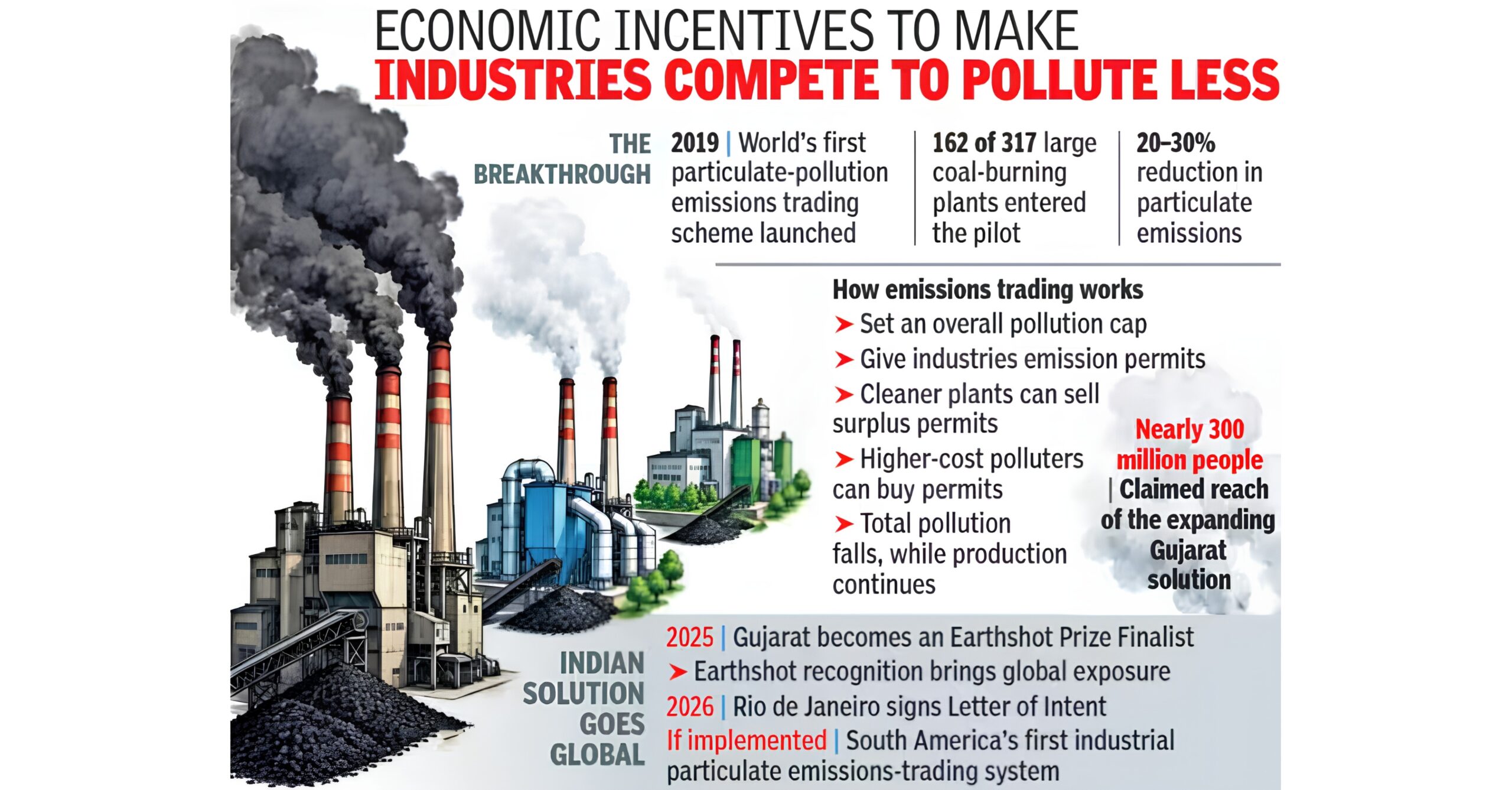
Researchers believed there was a better way — one that rewarded environmentally cleaner factories, instead of treating every factory in the same way. The idea is simple. Regulators set a maximum pollution limit for an industrial cluster and divide it into permits.
Factories that cut emissions beyond their target can sell surplus permits to plants finding it harder or costlier to clean up. Cleaner factories can earn, while others get flexibility to comply. At the same time, the pollution stays within the overall cap. The approach was piloted in Surat in 2019 by researchers affiliated with the Energy Policy Institute at the University of Chicago (EPIC) and J-PAL, which was working with Gujarat Pollution Control Board (GPCB).
The pilot covered 162 of Gujarat’s 317 large coal-burning industrial plants, while the rest remained under conventional regulation, allowing researchers to compare the two approaches.