


India’s urban transition faces the challenge of deteriorating air quality, with rapid motorization emerging as a major contributor.
Over the past decade, the number of registered motor vehicles in India has more than doubled, crossing 420 million nationally, with urban cities accounting for a significant share of this growth.
This expansion has been accompanied by persistent air quality challenges.
Transport emissions are estimated to contribute between 20–40% of particulate pollution in major Indian cities, with significant variation across seasons and local conditions.
Delhi represents an extreme but instructive case within this broader trajectory, with over 13 million registered vehicles — among the highest per capita vehicle ownership levels in India.
The city continues to experience severe seasonal air pollution, particularly during the winter months.
At the same time, it has been at the forefront of policy innovation.
Delhi has been implementing a wide range of interventions spanning technology-enabled enforcement and fleet electrification of both public and private transport.
These efforts reflect a governance approach that is iterative, adaptive, and often undertaken under conditions of institutional complexity.
EPIC India’s Transport team has been working closely with the Transport Department, GNCTD, providing evidence-led policy support for implementing these interventions. Taken together, Delhi’s experience offers a valuable empirical basis for understanding how transport and air quality policy evolves in practice, and how institutional arrangements shape outcomes.
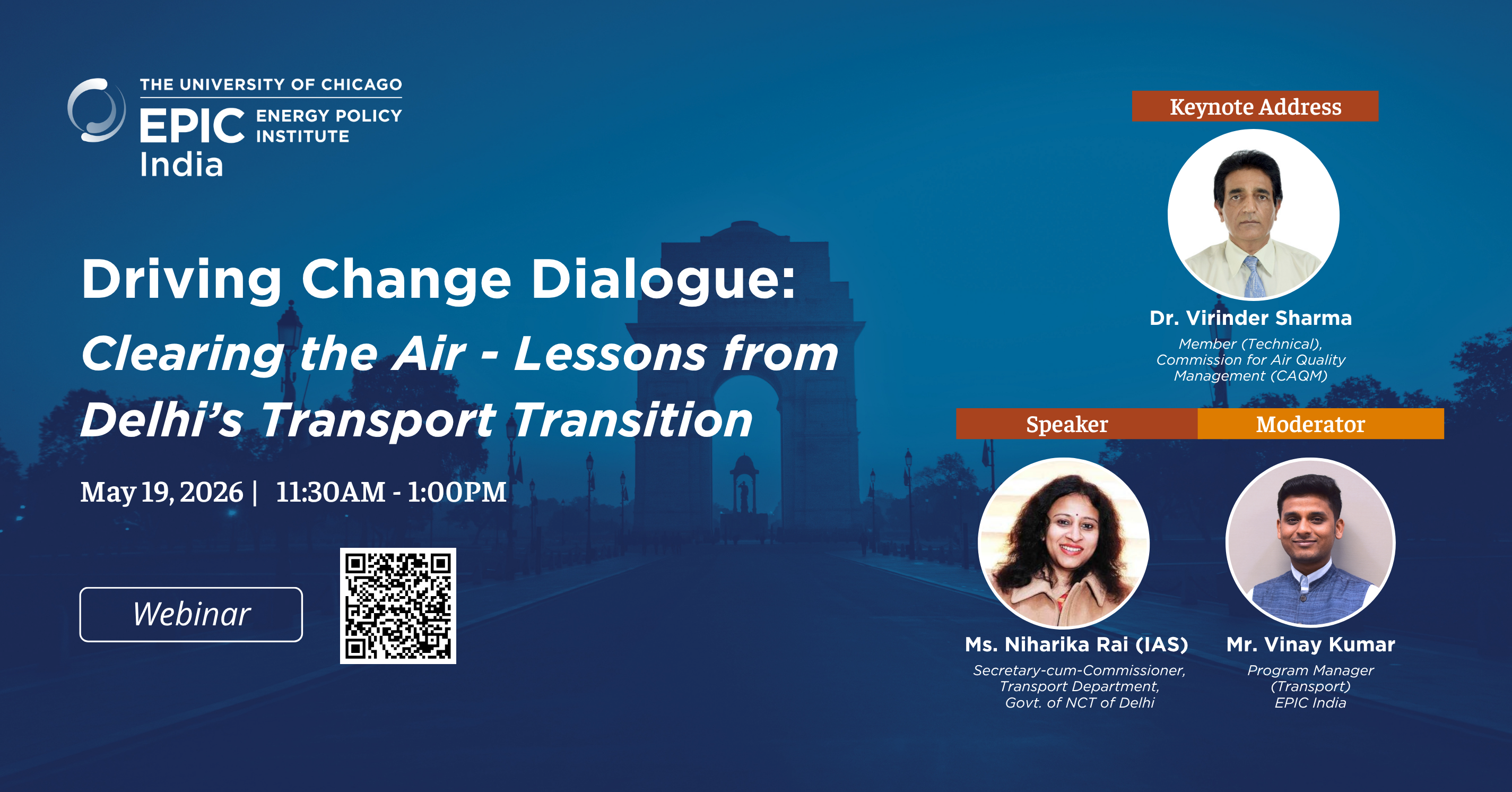
The Driving Change Series
The Driving Change series, convened under the EPIC India Transport Program, is designed as a platform for sustained, expert-focused engagement on critical questions at the intersection of transport emissions and air quality policy.
The series builds on two earlier Driving Change conferences held in January and December 2025, which brought together senior government officials, researchers, and sector experts to examine structural shifts in India’s clean mobility landscape.
As the third edition in this series, the Driving Change Dialogue format is intentionally more focused and conversational. Each dialogue edition will spotlight a single senior expert and is structured as a moderated exchange rather than a panel or presentation-led discussion.
The objective is to enable more in-depth, experience-based reflection on policy design, implementation, and institutional decision-making. This edition of the Driving Change Dialogue focuses on Delhi’s transport transition as experienced from within the government.
About our speaker
Ms. Niharika Rai (IAS), Secretary-cum-Commissioner of Transport, Government of NCT of Delhi