* AI-generated translation of the French article.
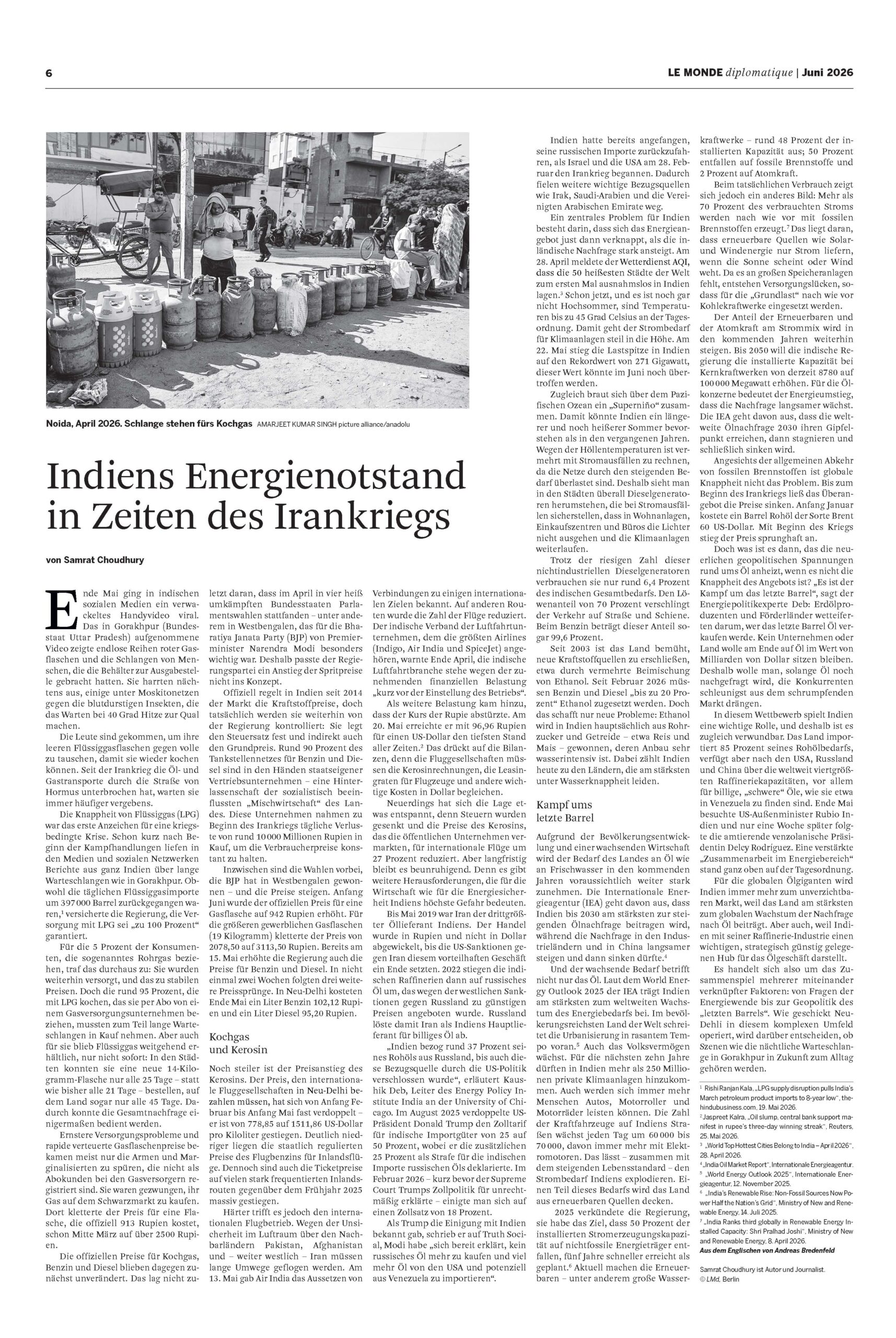
A shaky mobile phone video went viral on Indian social media in late May. Filmed in Gorakhpur, Uttar Pradesh, it showed endless rows of red gas cylinders and the queues of people who had brought their containers to the distribution point. They waited through the night — some under mosquito nets — enduring 40-degree heat and the insects that made the wait unbearable.
People had come to exchange their empty LPG cylinders for full ones, so they could cook again. Since the Iran war disrupted oil and gas shipments through the Strait of Hormuz, they have increasingly waited in vain.
The LPG Crisis
The shortage of liquefied petroleum gas was the first sign of a war-induced crisis. Shortly after fighting began, reports emerged from across India — in media and on social networks — of long queues like the one in Gorakhpur. Although daily LPG imports had fallen by 397,000 barrels, the government assured the public that LPG supply was “100 percent” guaranteed.
For the 5 percent of consumers receiving piped gas, this was accurate — they continued to be supplied at stable prices. But the roughly 95 percent who cook with LPG, supplied via subscription from gas distributors, sometimes faced long waits. LPG remained largely available, just not immediately: in cities, a new 14-kg cylinder could only be ordered every 25 days instead of the previous 21; in rural areas, only every 45 days. This allowed overall demand to be broadly met.
More serious supply problems — and rapidly rising cylinder prices — were felt mainly by the poor and marginalised, who are not registered as subscribers with gas suppliers. They were forced to buy on the black market, where by mid-March the price for a cylinder officially costing 913 rupees had climbed above 2,500 rupees.
Official prices for cooking gas, petrol, and diesel initially remained unchanged. This was partly because parliamentary elections were taking place in four closely contested states in April — including West Bengal, which was particularly important for Prime Minister Narendra Modi’s Bharatiya Janata Party. A rise in fuel prices did not suit the ruling party’s plans.
India has officially had market-based fuel pricing since 2014, but in practice the government continues to control prices — it sets the tax rate and indirectly the base price. Around 90 percent of the petrol and diesel distribution network is in the hands of state-owned companies — a legacy of the country’s socialist-influenced mixed economy. At the start of the Iran war, these companies absorbed daily losses of around 10 billion rupees to keep consumer prices stable.
The elections are now over. The BJP won in West Bengal — and prices are rising. In early June, the official price for a gas cylinder was raised to 942 rupees. For larger commercial cylinders of 19 kg, the price jumped from 2,078.50 to 3,113.50 rupees. On 15 May, the government also raised petrol and diesel prices. Three further price hikes followed in less than two weeks. By late May, a litre of petrol in New Delhi cost 102.12 rupees and a litre of diesel 95.20 rupees.
Cooking Gas and Kerosene
Kerosene prices have risen even more steeply. The price paid by international airlines in New Delhi nearly doubled between early February and early May — from $778.85 to $1,511.86 per kilolitre. State-regulated prices for aviation fuel on domestic flights are considerably lower, but even domestic ticket prices have risen sharply on many busy routes compared to spring 2025.
The international aviation sector has been hit harder still. Due to airspace uncertainty over neighbouring countries — Pakistan, Afghanistan, and further west, Iran — lengthy detours are required. On 13 May, Air India announced the suspension of flights to several international destinations; on other routes, frequency was reduced. The Indian airline industry body — representing Indigo, Air India, and SpiceJet — warned in late April that Indian aviation was “on the verge of shutting down” due to mounting financial pressure.
A further blow came from the collapse of the rupee. On 20 May it hit an all-time low of 96.96 rupees to the US dollar — weighing heavily on airlines, which must pay fuel bills, aircraft leasing costs, and other key expenses in dollars.
The situation has since eased somewhat, with taxes cut and public-sector kerosene prices for international flights reduced by 27 percent. But the long-term picture remains troubling. Deeper challenges pose serious risks to both India’s economy and its energy security.
The Geopolitics of Supply
Until May 2019, Iran was India’s third-largest oil supplier. Trade was conducted in rupees rather than dollars, until US sanctions against Iran ended this advantageous arrangement. In 2022, Indian refineries switched to Russian oil, which was available at favourable prices due to Western sanctions on Russia. Russia thus replaced Iran as India’s primary source of cheap oil.
“India was sourcing around 37 percent of its crude oil from Russia — until that supply source too was closed off by US policy.”
— Kaushik Deb, head of the Energy Policy Institute India, University of Chicago
In August 2025, US President Donald Trump doubled the tariff on Indian imports from 25 to 50 percent, declaring the additional 25 percent a penalty for India’s imports of Russian oil. In February 2026 — shortly before the Supreme Court ruled Trump’s tariff policy unlawful — a tariff rate of 18 percent was agreed.
When Trump announced the deal with India, he wrote on Truth Social that Modi had “agreed to stop buying Russian oil and to import much more oil from the US and potentially from Venezuela.”
India had already begun scaling back Russian imports when Israel and the US started the Iran war on 28 February. That further cut off key supply sources including Iraq, Saudi Arabia, and the United Arab Emirates.
Demand Surge Meets Supply Squeeze
A central problem for India is that energy supply is tightening precisely when domestic demand is surging. On 28 April, the weather service AQI reported that for the first time, all 50 of the world’s hottest cities were in India. Temperatures of up to 45°C are already commonplace — and peak summer hasn’t even arrived. Air conditioning demand is rising sharply. On 22 May, India’s peak power demand hit a record 271 gigawatts — a figure that could be surpassed in June.
At the same time, a Super El Niño is forming in the Pacific, potentially bringing an even longer and hotter summer than in recent years. Extreme temperatures are expected to cause more power outages as grids buckle under rising demand. Diesel generators are everywhere in cities, keeping lights on and air conditioning running in residential complexes, shopping centres, and offices when the power goes out.
Despite the enormous number of these non-industrial diesel generators, they account for only about 6.4 percent of total Indian consumption. Road and rail transport account for the lion’s share — 70 percent. For petrol, this figure is as high as 99.6 percent.
Since 2003, India has been working to develop new fuel sources, including through increased ethanol blending. Since February 2026, petrol and diesel must contain up to 20 percent ethanol. But this creates new problems: ethanol in India is produced mainly from sugarcane and grains — rice and maize — whose cultivation is highly water-intensive. And India is already among the countries most severely affected by water scarcity.
The Fight for the Last Barrel
Given population growth and a growing economy, India’s demand for both oil and fresh water is expected to continue rising sharply in the coming years. The IEA projects that India will contribute most to rising global oil demand through 2030, while demand in developed countries and China slows and then declines.
The growing need extends beyond oil. According to the IEA’s World Energy Outlook 2025, India is contributing most to global energy demand growth. In the world’s most populous country, urbanisation is proceeding at a rapid pace. Wealth is growing too. Over the next ten years, more than 250 million private air conditioners are expected to be added in India. More and more people will be able to afford cars, scooters, and motorcycles. The number of vehicles on India’s roads grows by 60,000 to 70,000 every day — increasingly electric. Together with rising living standards, this is causing India’s electricity demand to explode. Some of this demand will be met by renewables.
In 2025, the government announced it had achieved its target of 50 percent non-fossil installed power generation capacity five years ahead of schedule. Currently, renewables — including large hydropower plants — make up around 48 percent of installed capacity; fossil fuels account for 50 percent and nuclear for 2 percent.
But actual consumption tells a different story: more than 70 percent of electricity consumed is still generated from fossil fuels. This is because renewables like solar and wind only generate power when the sun shines or the wind blows. Without large-scale storage facilities, supply gaps persist, and coal power plants continue to provide baseload.
The share of renewables and nuclear in the energy mix will continue to grow in the coming years. By 2050, the Indian government aims to increase installed nuclear capacity from the current 8,780 megawatts to 100,000 megawatts. For oil companies, the energy transition means demand grows more slowly. The IEA expects global oil demand to peak in 2030, then stagnate and eventually fall.
Given the broader shift away from fossil fuels, global scarcity is not the problem. Until the start of the Iran war, oversupply was driving prices down. In early January, a barrel of Brent crude cost $60. With the start of the war, prices jumped sharply.
So what is driving the renewed geopolitical tensions around oil, if not supply scarcity?
“It is the fight for the last barrel.”
— Kaushik Deb, energy policy expert, EPIC India
Oil producers and exporting countries are competing over who will sell the final barrel. No company or country wants to be left sitting on billions of dollars’ worth of oil. So while oil is still in demand, they want to push competitors out of the shrinking market as quickly as possible.
India plays an important role in this competition — and is therefore also vulnerable. The country imports 85 percent of its crude oil needs, but has the world’s fourth-largest refining capacity after the US, Russia, and China — primarily for cheap, heavy oils like those found in Venezuela. In late May, US Secretary of State Rubio visited India; just a week later, acting Venezuelan President Delcy Rodríguez followed. Enhanced energy cooperation was at the top of the agenda.
For global oil majors, India is becoming an indispensable market — not only because it contributes most to global oil demand growth, but also because India’s refining industry represents an important, strategically well-positioned hub for the oil trade.
It is, then, the interplay of several interconnected factors: questions of the energy transition and the geopolitics of the last barrel. How skilfully New Delhi navigates this complex environment will determine whether scenes like the night-time queue in Gorakhpur become a routine part of everyday life.
Read the original article: Indiens Energienotstand in Zeiten des Irankriegs.